From open questions to answers
Everything we buy begins as a set of open questions.
For a site: will it be permitted, will it have power, will it be built?
For a credit or a company: can the structure be fixed, can the value be released?
Our work is to answer those questions — investing our own capital while we do — so that what was complicated becomes something a partner can join or a business can grow on.
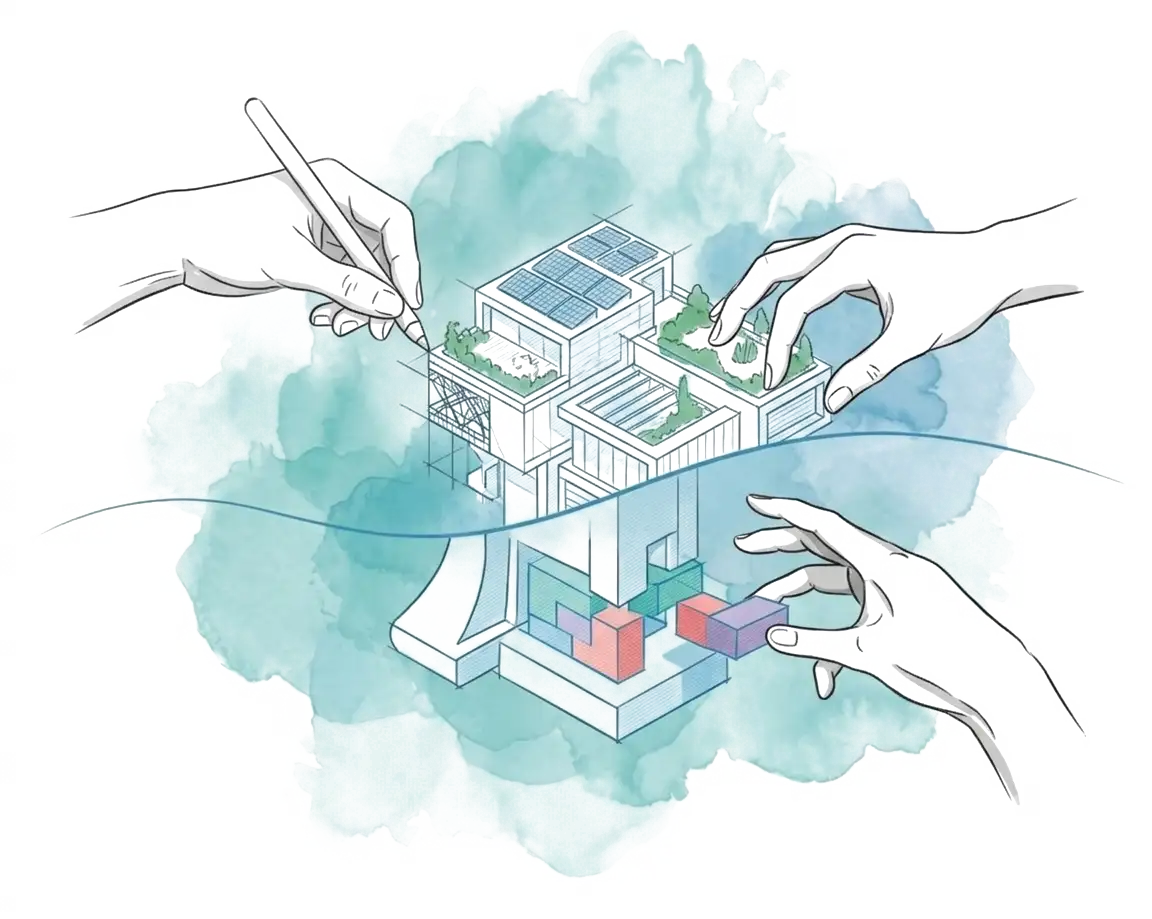
The repeatable sequence
We pick trends that will run for decades, and inside each trend we cherry-pick the niche where the payoff is asymmetric: where technical barriers keep competition thin (Porter, 1979), and a limited, controlled downside buys access to uncapped upside. Then we back an entrepreneur who knows the industry from the inside, build a solid team around them and put the group's capital and method behind it. Five platforms in, the sequence hasn't changed: each new one inherits what the previous ones learned.
Three roles, one trait
Lio companies create value in different ways. Three platforms develop real assets, one invests in special situations, and one compounds the proceeds into industrial ownership. What they share is a culture of disciplined, data-driven investing, and capital that is permanent in all three roles.
Development platforms 0 → 1 · THIEL, 2014



DC, Energy and Capital originate opportunities, secure control of the underlying asset and carry it through permitting to a ready-to-build stage — from there it is sold, leased or co-developed with a strategic operator
Investment platform

SSG works illiquid, cash-generative special situations — distressed credit, insolvency proceedings and illiquid assets — and grows precisely when markets seize
Compounding platform
1 → n · THIEL, 2014 | KAPLAN & STRÖMBERG, 2009

Industries acquires control or co-control of industrial companies with proven products and profitability, in partnership with the entrepreneurs who run them. It holds with no exit horizon: profits stay in the businesses and compound into long-term industrial ownership
The trait is the same everywhere: take what is tangled, and untangle it.
A bridge for institutional
capital
Nobody wants a permit. They want power, on time. CHRISTENSEN, 2003
Where others see risk, we see the price of entry. The world's leading institutional investors want exposure to Italian real assets: data centers, renewable energy, landmark hospitality. What their mandates cannot absorb is the early risk: permitting, grid queues, planning, disputes. That risk is our job. In each development vertical, Lio identifies the asset, resolves its complexity and funds the entire early phase with its own capital, as first-loss equity. Partners enter above our position, in the form their mandate allows: acquiring at ready-to-build, co-developing alongside our committed equity, or investing through senior instruments within our club-deal network. Our capital sits below our partners' in every structure. That is the bridge: international capital on one side, Italy's scarcest assets on the other, Lio's balance sheet in between.
The early risk stays with us. Partners enter once asset is de-risked.
Why Italy
In the early nineties, Italy was the fifth-largest economy in the world, with a GDP larger than that of China and India combined. Then the trains started leaving without it.
Computing and semiconductors: Olivetti had built Europe's first personal computers. Pharmaceuticals: the Milanese labs that discovered doxorubicin, still one of the world's most used cancer drugs, were sold abroad in 1993. Telecoms: the country that invented prepaid mobile watched the industry consolidate elsewhere. Then the internet, the software economy, the first solar manufacturing wave — industries Italy helped invent, scaled by others while capital here hesitated.
The trains leaving now are digital infrastructure, AI and renewables, and they are multi-decade: this time the country cannot afford to watch. Our development platforms exist to reverse the trend. The work is a bet on Italy's competitiveness — we would like it to count towards its renaissance.